Towards a future where anyone, anywhere in the world
can easily engage in land-based
aquaculture.
News
Challenges of land-based aquaculture
The limitations of custom systems that pursue economies of scale.
01
It requires specialized knowledge and has a high barrier to entry.

02
Individual designs for each site make expansion and modification difficult.

03
Filtration equipment is expensive and has high initial costs.

04
The launch period is long and the risk of changes in the business environment is high.

Towards solving aquaculture challenges
To solve the challenges of land-based aquaculture and transform it into an industry that “anyone can start,” a new “modular aquaculture technology” has been developed and is being promoted to international standardization.

Amid rising global demand for seafood, aquaculture is expanding as a vital industry supporting the food supply.
In Japan, expectations for a stable supply are rising, and in recent years, “land-based aquaculture,” which is less affected by weather and sea conditions and can be produced in inland and urban areas,has attracted particular attention.
As it contributes to food security and decentralized production,the government is also promoting technological development,social implementation,and international standardization.
On the other hand, land-based aquaculture is not an easy industry to start.
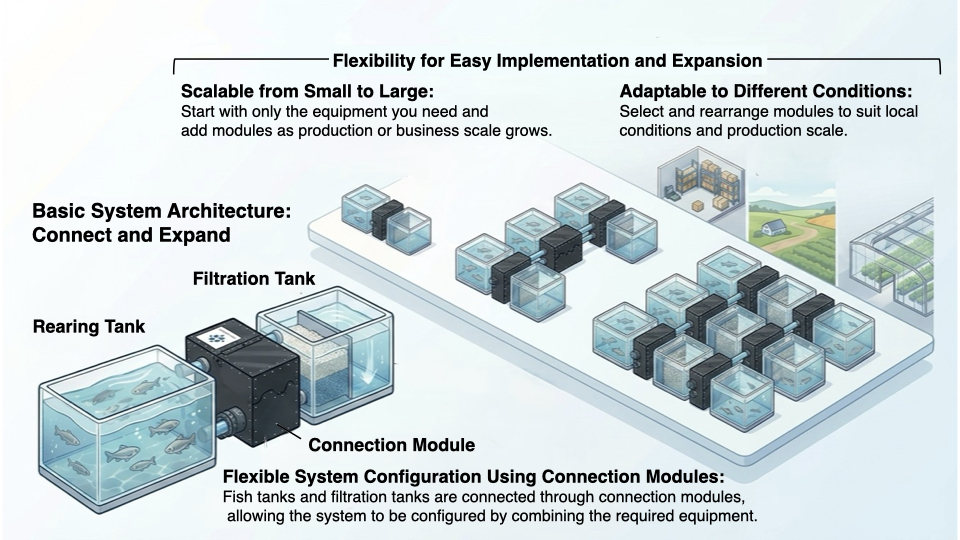
Conventional systems have complex, integrated structures that prioritize efficiency, resulting in low compatibility and expandability, and making small-scale implementation difficult . The modular land-based aquaculture technology “AQUAXMGRID” is a technical standard that solves these problems.
Innovation & Technology

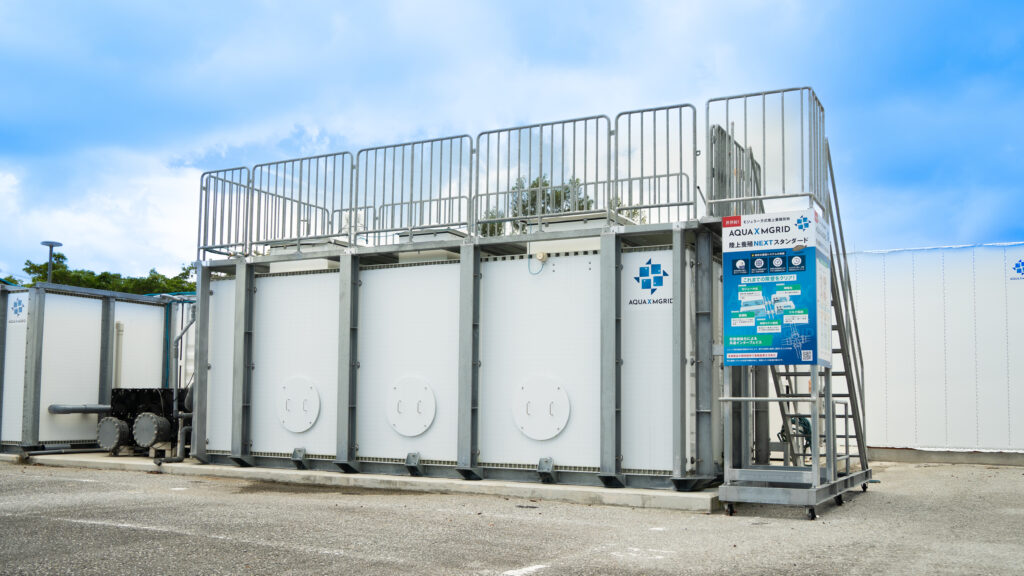
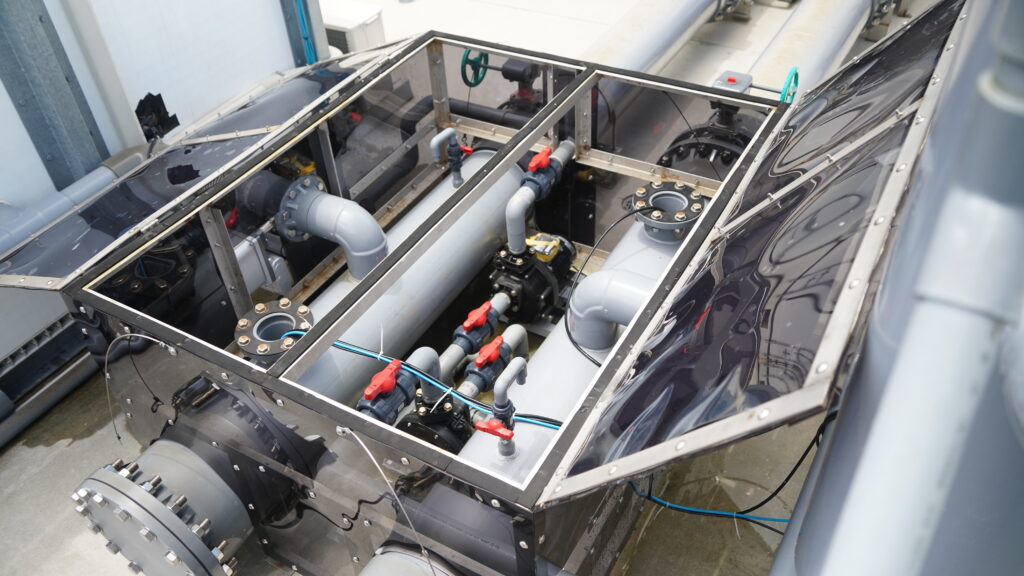
The aquarium tanks and filtration systems are modularized and can be connected like Lego blocks.
Standardization of connections between units.
The addition of independent units enables expansion of production scale.

Optimal distribution of filtration capacity reduces the need for excessive filtration equipment.

Only the unit experiencing the problem can be isolated, allowing for optimal operation with the remaining units.
Supports small-batch, high-mix production tailored to local needs.
Vision
“We want to solve the world’s food challenges.” What kind of Japan and world does AQUAXMGRID aim for?
Making global food production more free and more accessible.
Globally, population growth, climate change, and depletion of marine resources have created a major challenge in ensuring a stable supply of protein.
While aquaculture is seen as a promising solution, high barriers to entry, such as massive investment, advanced expertise, and dependence on local and environmental conditions, have prevented it from fully reaching society. We want to change this situation.
AQUAXMGRID’s goal is not simply to provide aquaculture equipment. It’s to create a social infrastructure that enables anyone, anywhere, to start sustainable aquaculture on the scale they need. To achieve this, we are working on building a modular, distributed RAS system and the international standards that support its connectivity. Instead of a closed system dependent on specific manufacturers or technologies, we aim to create an open ecosystem where companies and engineers worldwide can freely participate and connect. Technological innovation will accelerate on a standardized interface, allowing aquaculture operators to freely choose the optimal technology. This will create a sustainable food production network in which not only large-scale operators, but also local communities, emerging countries, and small and medium-sized enterprises can participate. Our goal is not simply to improve the efficiency of aquaculture. We aim to create a society where everyone around the world can participate in sustainable food production.
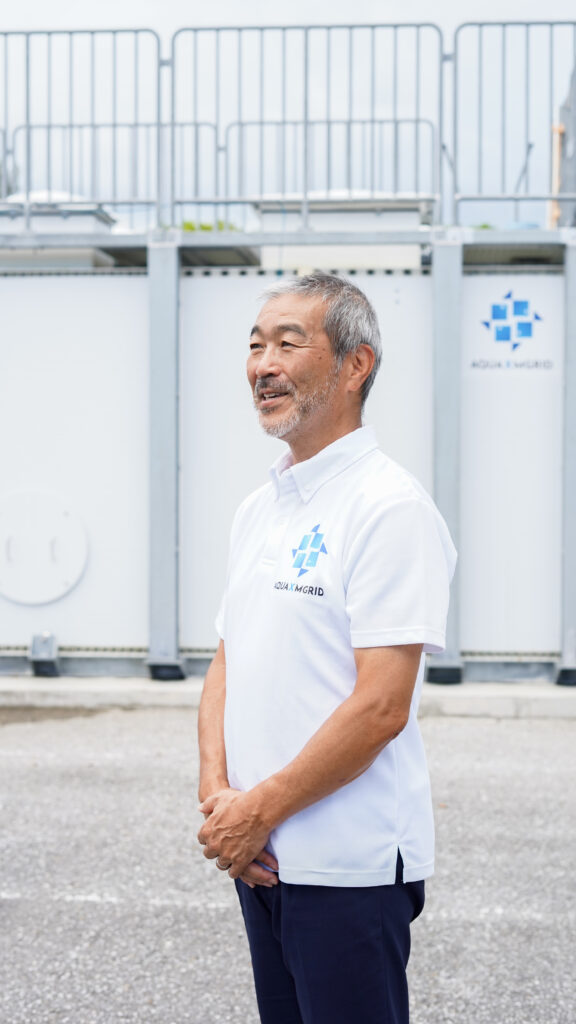
Kenji Taima, Representative of the AQUAXMGRID Initiative / PhD (Engineering)
Let’s share this technology with the world.
The AQUAXMGRID initiative is a standards organization that promotes the international standardization of modular, decentralized land-based aquaculture technologies.
We are working towards proposing a standard for ISO/TC234 (Fisheries, Aquaculture, and Fisheries) with a target date of 2029.
ISO/TC234 is
an ISO technical committee that develops international standards in the fisheries, aquaculture, and marine products sectors. It sets rules that affect the entire industry from a global perspective, including specifications for aquaculture equipment, environmental standards, and data management methods. Norway serves as the secretariat country, and companies, research institutions, and government agencies from all over the world participate. Certification of a standard by this committee means that the technology is recognized as a “world standard.”
For media inquiries and other questions, please contact us here.